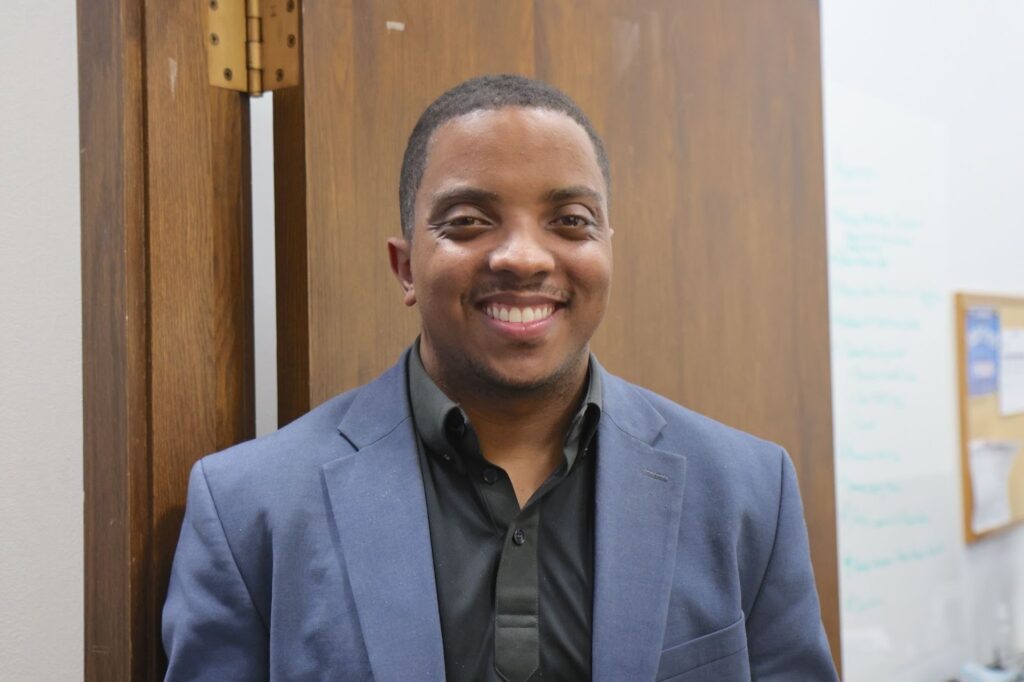
Julian Nicks joined City Hall to assist with a mayoral transition. Within weeks, he was helping with the city’s tornado recovery.
Months after the storm, residents across St. Louis have many questions: when will debris be cleared, how and when will damaged homes be stabilized or demolished, and what will recovery look like in neighborhoods that were already struggling long before the tornado hit.
At the center of those questions is Nicks, now serving as the city’s Chief Recovery Officer. In an exclusive sit-down with NextSTL, he laid out how the city’s response has taken shape, where it has fallen short, and what comes next.
As the city continues to navigate the complexity of tornado relief—and residents remain frustrated by what feels like a lack of progress—Nicks lays out where things stand, why recovery has moved slowly, and what is beginning to change.
The early days of emergency response
When the tornado hit St. Louis on May 16, 2025, it quickly became clear the city was not equipped with a ready-made framework for responding to a disaster of that scale.
“We had no structure for how to think about emergency response,” Nicks said. “We had no standard protocols.”
In the days immediately following the storm, a small group of city staff from the Mayor’s office and other departments—what Nicks described as “the group of the willing”—assembled without a formal disaster playbook or guidance from anyone who had managed a disaster of that scale.
“We were in the room trying to figure out how to do and manage an emergency disaster response,” Nicks said.
That early effort centered in the city’s Emergency Operations Center, a structure designed for short-term crisis coordination and rapid decision-making. Staff from other city departments, along with county volunteers and state partners, stepped in to support the response. For weeks, that framework fit the moment as the city focused on immediate safety and stabilization.
But as the full scope of the damage became clearer—and the problems multiplied beyond what could be solved through short-term coordination—it was evident the city was no longer dealing with a typical emergency.
“This isn’t something that was going to be over in two months,” he said. “It’s going to be a long journey for St. Louis City residents.”
Nicks discussed that reality directly with Mayor Cara Spencer, and they agreed that the city needed to move beyond crisis management and begin planning for sustained recovery.
“We decided we needed a recovery office,” he said. “A dedicated team similar to the EOC, but focused on longer-term thinking—people who wake up every day thinking about the tornado and how we help residents recover.”
That shift—from emergency response to long-term recovery—would go on to shape everything that followed, from how the city allocates funding to how it communicates with residents still waiting for visible change.
But the limits of the city’s recovery systems aren’t theoretical. They shape what residents experience on the ground, and Nicks sees those differences firsthand.
Living inside the disaster—and seeing the disparity
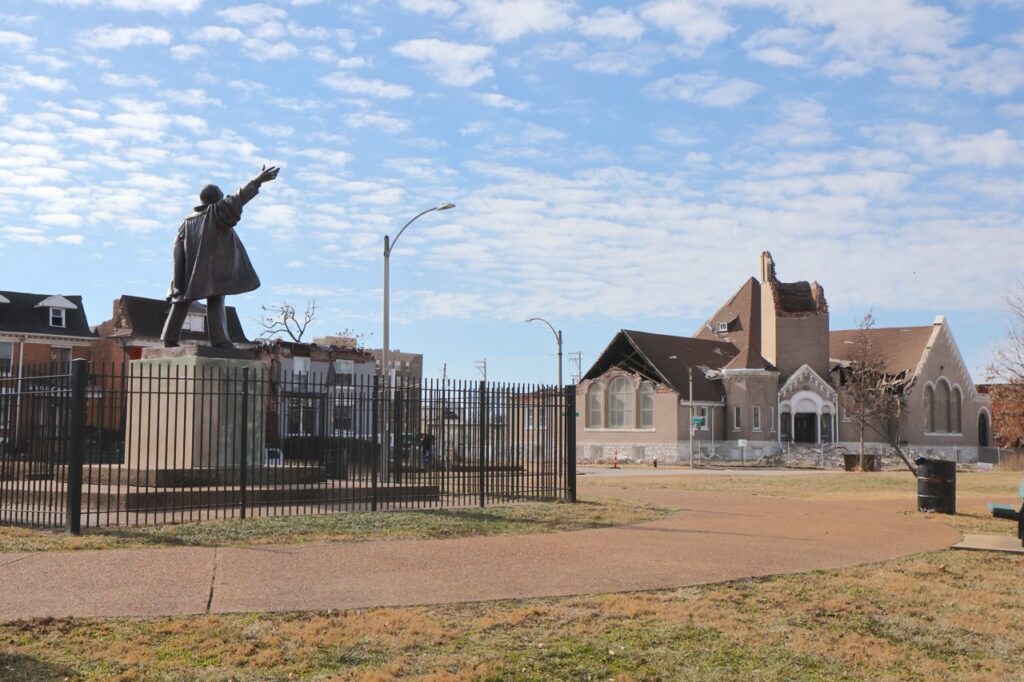
Nicks lives in the Central West End. He readily acknowledges that his neighborhood has seen a different recovery than much of the city.
“You see my street and those houses right after the tornado, and where they are now—and how much has gotten better,” he said. “And you look at the other streets in most of North St. Louis, and it hasn’t.”
Nicks is clear-eyed about the reality in St. Louis, where North St. Louis faces economic inequality layered on top of decades of disinvestment. He’s often asked whether recovery would have looked different if the tornado had hit south St. Louis instead of north, and he doesn’t hesitate.
“It doesn’t take a lot to see—just looking at the difference between south of Delmar and north of Delmar—to know the recovery is different,” he said.
Nicks explained that south of Delmar, homeowners are more likely to be adequately insured. Higher property values support that coverage, and residents and neighborhood associations often have additional resources—allowing them to hire private contractors, remove debris, replace roofs, and begin rebuilding even while insurance claims are still being processed. That access to resources helps explain why some neighborhoods have recovered faster than others.
“In most places hit by a tornado, the lion’s share of the recovery effort you hope comes from private insurance,” Nicks said. “That’s why you have it.”
That model breaks down in North St. Louis.
One reason is property valuation. Homes that might be worth $250,000 to $300,000 elsewhere in the city are often valued at only $50,000 to $100,000 north of Delmar—figures shaped by decades of redlining and systemic devaluation. As Nicks pointed out, rebuilding costs don’t scale down just because property values do. A house valued at $50,000 can easily require two or three times that amount to rebuild.
“After this type of systemic racism and devaluation, we can’t be surprised that so many people in North St. Louis are uninsured or underinsured,” Nicks said. “The price of insurance and deductibles becomes way too high—and that’s assuming insurance companies offer residents any insurance at all.”
The result leaves many residents dependent on government aid—and understandably frustrated when that assistance doesn’t arrive quickly enough.
What recovery looks like on the ground
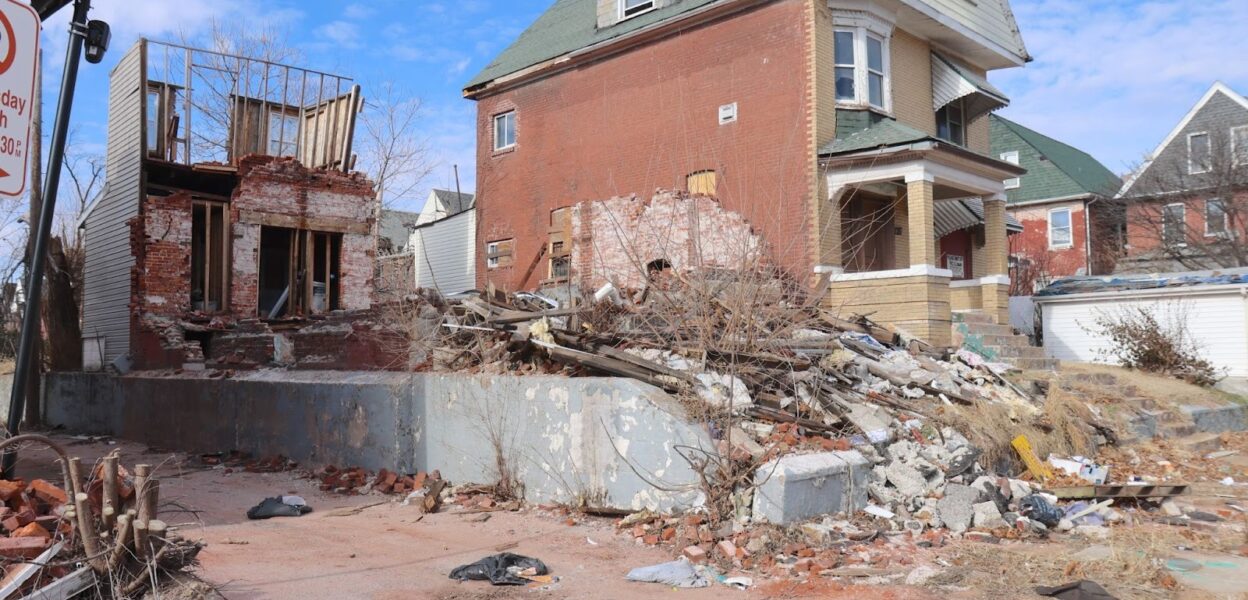
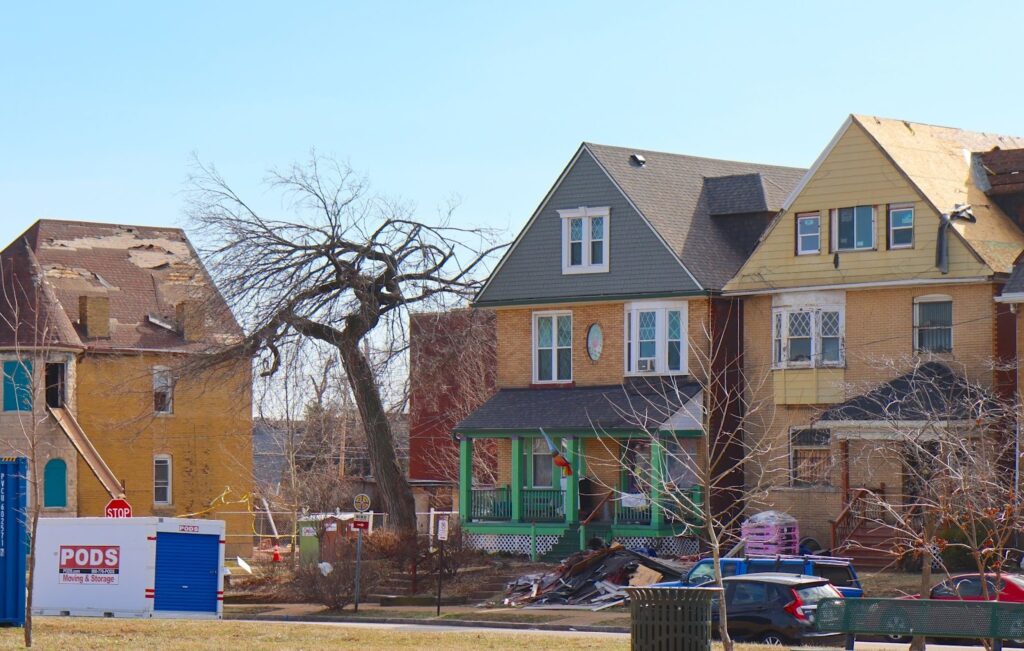
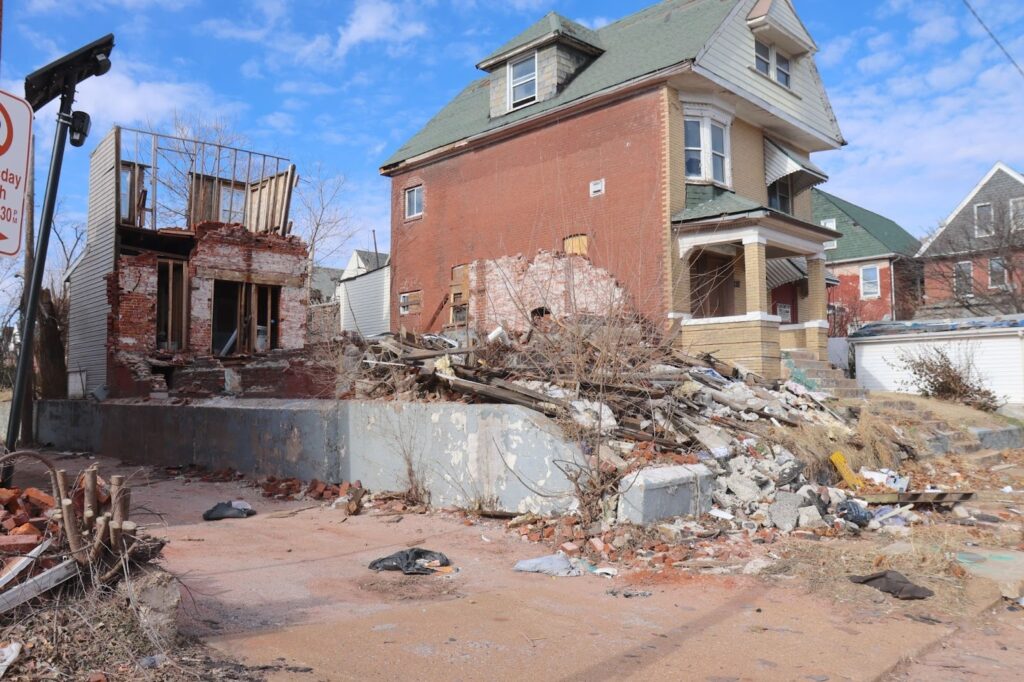
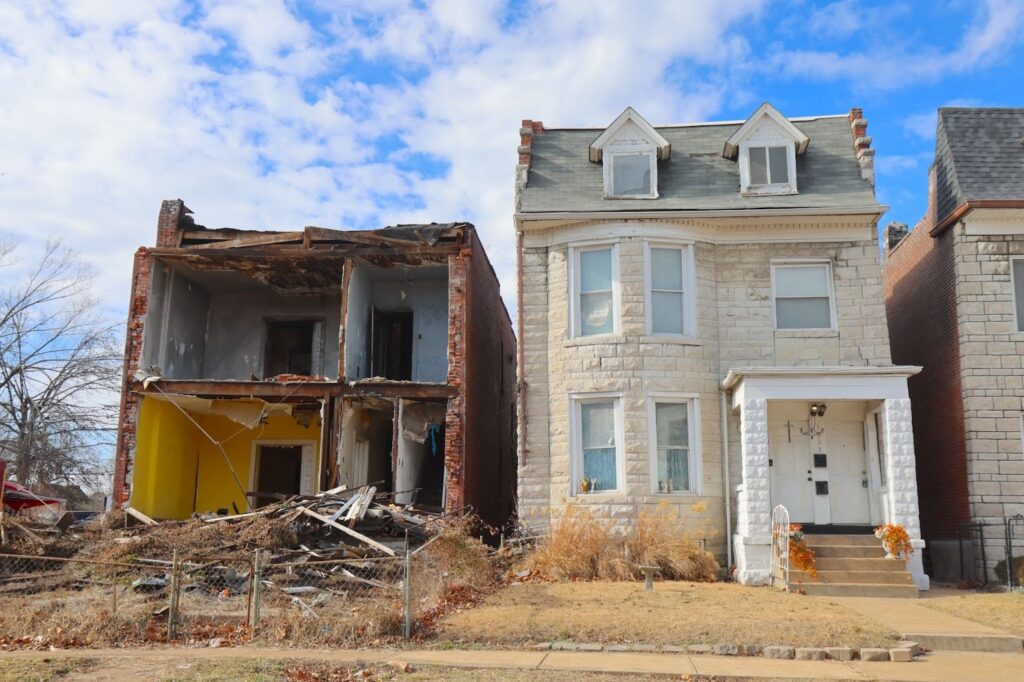
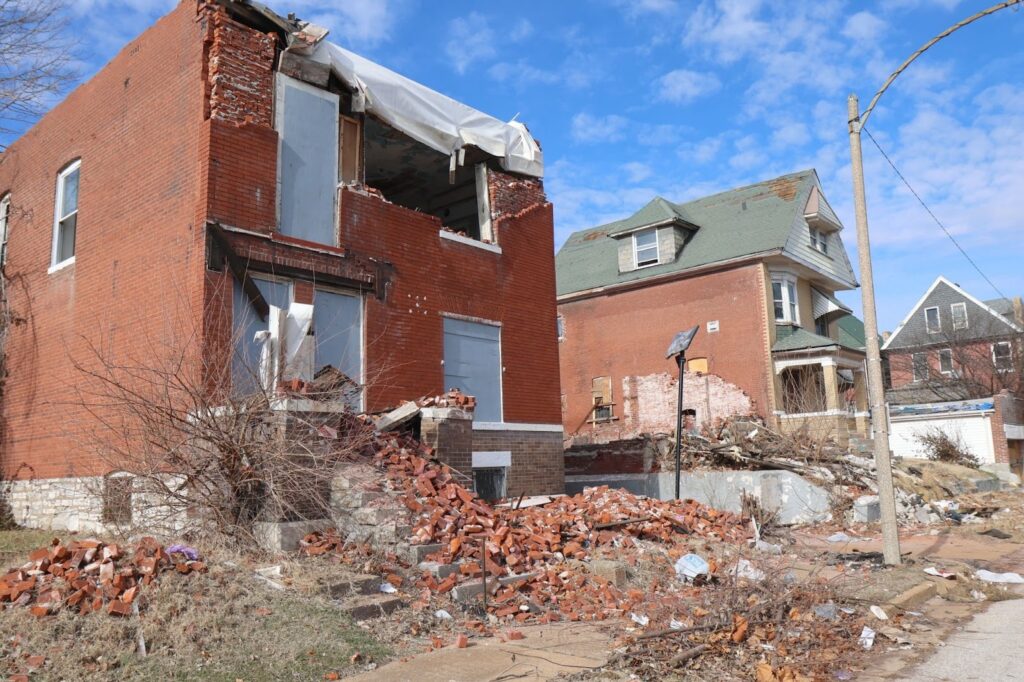
For residents, recovery isn’t abstract. It’s physical. Uprooted trees. Collapsed buildings. Homes that are half-standing. Piles of brick, roofing material, and downed limbs still line blocks across many neighborhoods, even when that debris technically sits on private property rather than in the street.
“The number one thing people care about at the end of the day—the most visible form of progress—is debris,” Nicks said. And as he acknowledged, large-scale demolition and debris removal, particularly on private property, have barely begun.
Faced with heaps of lumber, shingles, and rubble that haven’t moved in months, residents understandably ask why the city can’t simply remove all of it.
Nicks emphasized that a significant amount of early work did happen in the days immediately following the storm, driven in large part by community effort. Residents, volunteers, and nonprofit groups moved debris out of damaged homes and onto curbs, stacked bricks, and cut up fallen trees, making it possible for City Forestry teams, Parks and Recreation crews, and contractors to focus on reopening streets, restoring traffic signals and streetlights, and clearing hundreds of thousands of tons of debris from public rights-of-way.
That work, he said, was substantial, but it didn’t address all of the destruction residents still live with every day.
“What we’re left with now is all the stuff on private property,” Nicks said. “And that’s what matters most to neighbors, and where we have the most work left.”
That remaining damage—collapsed roofs, unsafe structures, and debris bound up with buildings that require demolition or major repair—demands levels of funding and capacity beyond what the city has been able to deploy so far.
Because debris removal and demolition often qualify for FEMA reimbursement, the city has held back some local spending while waiting to see which projects outside programs will cover and under what terms. With limited recovery funds, moving too quickly risks draining resources needed for repairs, housing assistance, and other needs that federal programs won’t fund.
“This recovery is going to be expensive,” Nicks said. “We can’t try to pay for all the things that we know federal dollars can cover.”
That caution does not mean the city has failed to put money on the table. In broad terms, St. Louis has committed roughly $120 million to tornado recovery. Roughly $75 to $80 million of that total comes directly from city funds, including money tied to the Rams settlement and interest earnings. Nearly 90 percent of those dollars are expected to be under contract soon—meaning plans are in place even if residents haven’t yet seen the work happen at scale.
The challenge, Nicks said, is that committing money and delivering visible results are not the same thing. Between contracts, coordination, and reimbursement rules—especially when federal programs are involved—things take time.
That gap between what residents still live with every day and how quickly the city can move funds into action defines the hardest part of the recovery so far, and helps explain why progress has felt uneven across neighborhoods.
Recovering without a playbook
Nicks reiterated that delays are not simply the result of red tape. The problem, he said, isn’t bureaucracy for its own sake. It’s that the systems the city must rely on weren’t designed to be built and activated simultaneously.
“We’re trying to build a plane while flying it,” Nicks said.
The rules that govern contracts, reimbursements, and approvals are meant to protect public money. But they’re built for normal times, when projects can be planned in advance—not for a disaster that’s already on the ground and demanding action.
In St. Louis, the team working on recovery had to figure out how to work within those systems at the same time that residents waited to see debris move and buildings come down.
“The time to fix these systems wasn’t during the disaster,” Nicks said. “The system should just be working. And that’s what’s frustrating.”
State partners have been cooperative throughout the process. What’s slowed things down is bringing federal programs, state funding, and city contracts into alignment. The delay isn’t about people dragging their feet—it’s about working with systems that move carefully by design.
The result is a recovery effort that can feel stalled on the ground even as work continues behind the scenes. Nicks acknowledged that frustration and said the Recovery Office has been focused on clearing streets and alleys, collecting applications, and completing site inspections—work meant to set the stage for larger-scale action. As contractors are hired and onboarded, he said, visible work is expected to accelerate in March.
When insurance fails
Insurance has emerged as one of the most universal pain points after the storm, with many residents reporting delayed, disputed, or incomplete payouts from insurers. Nicks emphasized that the problem is not limited to low-income homeowners or underinsured properties in North St. Louis. It is affecting residents across the city.
He spoke from his own experience.
“As someone who has personally had to deal with insurance—I’m sorry,” Nicks said. “You bought insurance with the expectation that when an emergency hit, they would come through. And they haven’t.”
The problem is visible even among homeowners who are insured and financially stable. He mentioned how a couple of attorneys in Academy–Sherman Park are still struggling to receive insurance money for significant portions of their repairs.
“If two highly educated lawyers are struggling to get insurance payouts,” Nicks said, “what can possibly be happening with everyone else?”
For residents facing denials or prolonged delays, Nicks urged them to file formal complaints with the Missouri Department of Commerce and Insurance (DCI). The goal, he said, is not just individual resolution but documenting broader patterns of denial and delay across providers.
For residents who cannot move forward because insurance has stalled—or was never sufficient to begin with—Nicks pointed to the city’s Private Property Assistance Program as the most immediate step available.
The city-led program, supported by state and federal funding, is intended to fill gaps left by private insurance. Depending on eligibility and site conditions, it can fund stabilization and repairs to make homes livable again where feasible, demolish unsafe structures, and remove tornado-related debris or hazardous trees from private property.
Applying to the program also helps the Recovery Office understand who needs help, what kind of work each property requires, and how limited resources should be prioritized.
“We are, from a city standpoint, asking [all impacted] people to apply,” Nicks said. “We’re trying to get a view of all of the people who need support so that help can come their way.”
City officials have set February 14 as the deadline to apply for the program, a timeline tied to federal requirements and the need to coordinate work across agencies and contractors.
Nicks acknowledged that the program is not a quick fix. But he described it as the clearest path currently available for moving stalled properties toward repair or resolution—and for turning months of planning into visible progress on the ground.
Why the recovery in St. Louis isn’t like Joplin
Given how slow recovery has felt, many residents naturally look for comparisons, especially to other tornado-stricken cities where cleanup appeared to move faster. Joplin is often the example people point to.
But Nicks said that comparison misses some critical differences in how disasters are handled today, and in what St. Louis is actually dealing with on the ground.
Joplin benefited from an immediate and expansive federal response. Within seven weeks, roughly two-thirds of the debris had been cleared, largely through coordinated deployments of the U.S. Army Corps of Engineers and the National Guard, backed by a 90 percent federal cost share. Federal agencies arrived with personnel, contracts, and experience already in place, allowing cleanup and demolition to move quickly and at scale.
St. Louis, by contrast, is eight months out and only beginning large-scale debris removal.
Part of that difference, Nicks said, reflects a changed federal landscape. FEMA now plays a much more limited role, pushing responsibility down to states and cities. Local governments, however, don’t maintain standing disaster crews, pre-negotiated contracts, or teams of specialists ready to deploy at scale. In St. Louis, work that once would have been handled by national disaster experts was instead assembled locally and in real time—adding complexity and slowing the city’s response.
There’s also a fundamental difference in the nature of the destruction itself.
“Joplin was wiped out,” Nicks said. As a result, “it was easier to bring in dump trucks and cranes and clear entire blocks.”
St. Louis, by comparison, was hit unevenly. Some buildings must be demolished, others repaired, and many sit somewhere in between, requiring what Nicks described as a more surgical approach. Clearing damage one structure at a time slows progress and makes recovery harder to scale.
What happens next—and when
After months of planning and coordination, the city is now moving toward the phase residents have been waiting for: visible work on private property.
Agreements with the state to begin large-scale debris removal are being finalized, and right-of-entry permissions are already underway. At the same time, the city is preparing plans for properties that won’t qualify for FEMA funding, where local dollars will have to stretch further.
Major debris operations are expected to ramp up in March, with some early mobilization possible as soon as February. In limited cases, city crews may begin work ahead of state contractors.
Nicks cautioned that progress will not be simultaneous across neighborhoods.
“We’re not going to be able to do everything all at once,” he said. Still, the goal, he added, is “visible improvements as quickly as possible.”
A message to residents who are exhausted
When asked what he would say to residents who are angry, displaced, and losing faith, Nicks didn’t hold back.
“I’m frustrated as hell too,” he said. “The response from the city, the state, the federal government—it’s not fast enough. It’s not good enough. And it’s hard.”
He acknowledged that some decisions might have played out differently if federal guidance had been clearer from the start. “In retrospect, would we have done it differently?” Nicks said. “Maybe. We didn’t know what FEMA would do.”
What he pushed back against was the idea that slow progress reflects indifference.
“We do care,” he said. “We do know.”
Nicks urged residents to keep engaging, keep applying for assistance, and keep holding the city accountable—even as patience wears thin.
“We have every intention of reinvesting and rebuilding in North St. Louis,” he said. “We know goodwill is running out. We know it’s taking too long. And we’re coming as quickly as we can—even though we know it’s not fast enough.”
Photos by Jackie Dana, January 2026
Corrections: quotes from Nicks about the creation of the recovery office and availability of insurance were slightly modified at his request to better reflect his intent.
Private Property Assistance Program
If you know someone who owns damaged property (even if they no longer live there), please share this information.
- Apply by: Feb. 14
- Purpose: Repairs and stabilization, demolition of unsafe structures, and removal of tornado-related debris and hazardous trees
- Who should apply: all property owners with tornado-damaged buildings (residential, commercial, or mixed-use)
- Online: https://app.stlrecovers.com/
- In person: STL Recovers Outreach Center, 4401 Natural Bridge
- Phone: 1-833-925-0977
- Email: [email protected]
- Community meetings: Feb. 17 and March 17 (locations TBA)