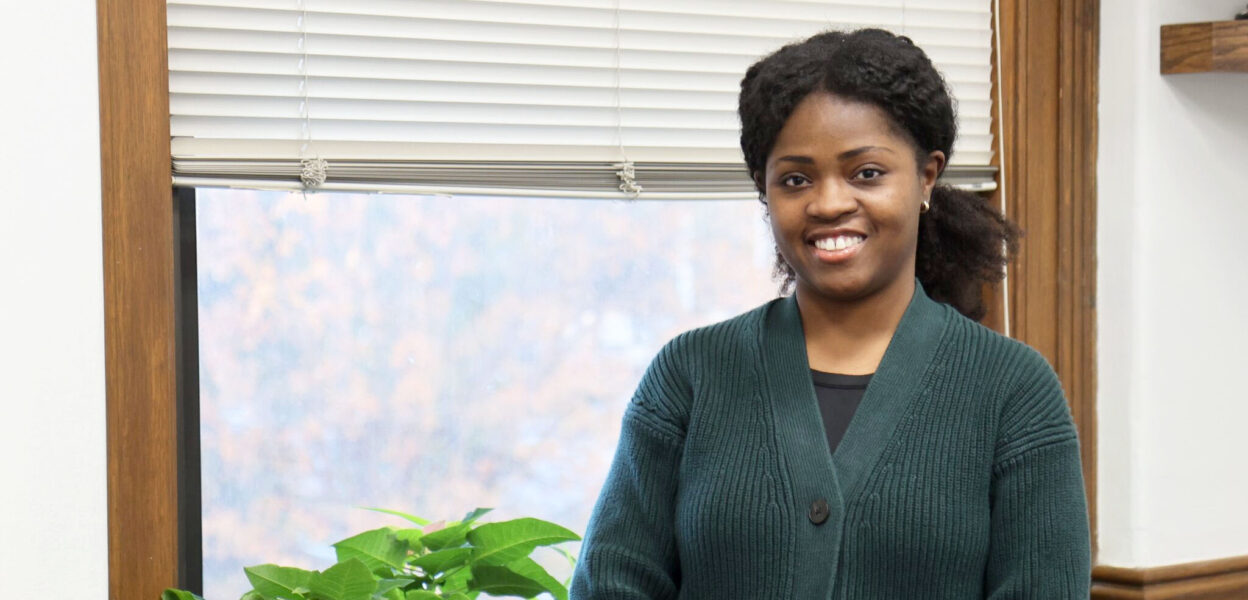
On July 1st, 2025, St. Louis voters chose a new representative for one of the city’s most complex and consequential areas: the 8th Ward. Stretching from Downtown through diverse historic neighborhoods, the ward offers a microcosm of St. Louis.
The person now leading the ward is Alderperson Jami Cox Antwi, a third-generation native St. Louisan who has spent her career working with communities. She grew up in University City, studied public policy and community development at Vanderbilt, and, after completing graduate studies in Global Affairs and Economics in China, chose to return home. Today, she lives in McKinley Heights with her partner and their daughter.
Serving the 8th Ward
“Sometimes you have to raise your hand and step up for the ideas that you have.”
Cox Antwi always imagined herself in public service. She ran for the open 8th Ward seat because she wanted to help shape St. Louis’s future, and the Board of Aldermen is where those decisions get made. As she explained, part of the job is straightforward constituent service — being the person you call “when you have a pothole on your street or a hole in your dumpster. But the broader work is thinking about what St. Louis should become. Representing such a varied ward gives her a wide lens on the city’s challenges.
One of her early priorities has been bridging divides within the ward. She makes a point of sharing perspectives from one neighborhood with residents of another. In her view, St. Louis has long had “a culture of isolationism,” where people assume “what’s happening in their neighborhood, in their backyard, is what matters to them, and nothing else matters.”
She pushes back by reminding people that “we’re all in this boat together.” As an example, downtown safety often comes up. Whether someone lives in Marine Villa, Mount Pleasant, Lafayette Square, or Clinton Peabody, they’re likely heading downtown for something — so downtown matters to everyone. To get this across, she widens the frame at neighborhood meetings. She starts with what’s happening at the executive level — “what’s the mayor saying, what’s the Board of Aldermen saying” — before turning to local concerns and downtown issues. That approach, she says, helps people see that “maybe what’s happening here isn’t necessarily the biggest thing going on in the city,” and it highlights the balancing act her role requires.
A Vision for the City
Cox Antwi believes St. Louis has immense potential, but the city hasn’t been meeting it. As she puts it, “I think we’ve kind of been humdrumming for a while on the same path, and unfortunately, it’s leading us in a not great direction.” She’s frustrated that discussions keep focusing on population decline, people leaving, and the sense that “we don’t have the population we need” without moving things forward.
To shift that trajectory, she argues that St. Louis needs people to start buying into big ideas, whether that’s the revised downtown plan or the City of St. Louis ZOning UPgrade (ZOUP).
She notes that several transformative initiatives are already underway, but confidence in them is low. “No one believes it, because we’ve had a lot of promises as a city,” she says, “and I think that’s what’s hard. Part of our jobs is to make sure that these promises start coming into fruition, so people can believe in St. Louis again.”
For her, the 8th Ward shows what that future could look like. Its population is growing and, as she notes, it is attracting talent, jobs, and new opportunities to the city as a whole. She believes that as the ward continues to evolve, its momentum can lift the whole city.
A Community-First Approach
It’s not enough for city leaders to push big ideas on their own. Cox Antwi emphasizes that “sometimes you have to have the momentum push come from the actual people of the city.” Residents need to advocate for their neighborhoods and show both officials and their communities what’s possible. “What makes the Soulard neighborhood or Benton Park so cool?” she asks. “What makes Clinton Peabody such a great community?”
She’s direct about what’s required. “One thing St. Louis really needs is people who want to live and invest in the backbone of the city,” she says, “and that’s how you get some of these projects to move to fruition. People have to see the city as a place that people want to live before others start building in it.”
That leads to another question: How do you get communities to lead development? Cox Antwi thinks she has the answer: “It starts with making sure that our communities are tight-knit, that they’re together,” and then making sure the city is listening. She argues for a development model driven by neighborhoods, one that helps communities define their identities and chart their own future. As she puts it, “that’s when we can start attracting the growth, the small businesses, the walkability, the things that actually make cities cool, that people actually want to live in.”
Part of that shift involves focusing on smaller investors and local businesses, not just large developers. “We need some mid-scale developers who can come in and build something that has a storefront and maybe residential at the top,” she explains. Recent changes, such as reallowing Accessory Dwelling Units and reducing minimum lot sizes, are, to her, the kinds of policy shifts that support walkable neighborhoods “with coffee shops, pet stores, and markets all nearby.”
Housing as a Priority
Cox Antwi has centered her first term on two issues: housing and transit. Both stem from the 8th Ward’s complexity. The ward includes some of the oldest housing in St. Louis, with expensive restored homes in some areas, while others struggle with long-neglected properties, vacant lots, and deep disinvestment. Industrial corridors sit next to dense residential streets and some of the city’s most diverse communities.
To her, the core challenge is a widening housing gap. Properties are often either too expensive for working families or too deteriorated to take on. She regularly hears from residents worried that the house next door might collapse. That’s why housing is her top legislative focus. She wants the city to help restore livable, affordable homes “so that people will want to live here, and we can increase the population.”
One of the biggest projects is the reconstruction of Clinton Peabody. As she notes, half the buildings have been torn down, “and that’s really transformed that community.” They will be rebuilt, and “we’re hoping it will be really beautiful and vibrant,” though “that takes a lot of work.”
Still, the ward’s broader challenges remain. “I do think that balance of priorities is something that I just ask for grace from people,” she says. She hopes that as she stays “open and honest and transparent about all the change that’s happening,” residents will begin to see the larger picture.
A Fresh Approach to Transit
Cox Antwi sees transit improvements as essential for the city and the region. She supports expanding bike lanes, strengthening pedestrian and bike safety, and upgrading roads, since cars remain part of daily life. Her guiding question: “How do we make sure we have a variety of transit options for the people who want them?”
She hopes to advance safety improvements along Gravois, building on the stretch already underway at Russell. Her goal is to extend those changes to Jefferson, adding traffic calming and new street crossings. “That was a big goal I had on the campaign,” she says.
When it comes to reducing reliance on cars, she argues St. Louis isn’t built for that transition yet — especially in parts of the 8th Ward. Reducing traffic in some neighborhoods can make them functionally landlocked, making everyday tasks like getting to work, reaching a grocery store, or using public transit more difficult, thereby intensifying disparities.
Still, she believes residential areas need alternatives. She favors protected bike lanes on smaller streets, such as Mississippi and Arsenal. “I should be able to bike from my area, McKinley Heights, to Benton Park, and I should be able to do that safely,” she says.
She also supports the city’s investment in larger corridors, including the Seventh Street project, Fourth Street, and the Tucker cycle track. She’s enthusiastic about upcoming connector routes and the Great Rivers Greenway vision. As she notes, “we’re hopefully going to have one of those major greenways going right down Market Street, which is a protected bike lane.”
Believing in St. Louis’s Potential
For Cox Antwi, the work she’s doing in the 8th Ward comes from a deep affection for the city itself. She describes St. Louis as a place with real character: layered history, a distinct culture, and an arts community that feels both accessible and alive. “Those things are the things that I really love,” she says. “So I would say there’s no other place like it, and I wouldn’t want to be anywhere else.”
That pride in her hometown shapes how she thinks about development and leadership. She believes the 8th Ward offers a glimpse of what St. Louis could become if the city embraces its strengths and invests with intention.
“The perspective that I’m pushing about developing in St Louis, again, comes from that potential that the 8th Ward has.” And she’s not just speaking to her constituents — she hopes other city leaders take note. “I’m hoping to put out to my fellow leaders of the city that if we start thinking about investing in St Louis differently, and start looking at the potential, the way I see it in the 8th Ward, that’s when St Louis will really change. And we’re on the cusp of that.”
In the end, the 8th Ward’s blend of issues offers persistent challenges, but it’s these challenges that make it the perfect test case for the city as a whole, and Cox Antwi approaches it with that in mind. The work she is pursuing there is meant to demonstrate what steady, community-focused investment can achieve.
Photo of Jami Cox Antwi by Jackie Dana