
On April 7, voters in the City of St. Louis will decide a single question: whether to continue the city’s earnings tax.
It’s a straightforward item on the ballot, but the implications are not. To understand what’s at stake, I looked at the tax’s history, how it fits into the city’s finances, and what could happen if it doesn’t pass. I also spoke with Mayor Cara Spencer and Collector of Revenue Gregory F. X. Daly to discover how those closest to the issue are thinking about it—and what they want residents to understand before voting.

What the earnings tax is and who pays it
About one-third of the city’s general revenue—roughly $208.5 million—comes from the earnings tax, a 1% tax on income.
It applies to:
- City residents, regardless of where they work
- Non-residents who work within the city
Those who are unemployed or retired do not pay the tax.
Daly said about 65% of earnings tax revenue comes from county residents. “If you’re coming into the city, you’re using the streets…you’re sharing in it.”
Mayor Spencer framed the tax as relatively equitable: “Earnings taxes are considered fairly progressive. By contrast, sales tax is considered regressive. An earnings tax is more evenly distributed across income levels.”
The revenue flows into the City’s general fund, supporting core services like police and fire, street maintenance, refuse collection, and parks.
Earnings taxes are not unique to St. Louis, and the city’s 1% rate is relatively modest. About a third of U.S. states allow some form of local income or earnings tax.
Here are some examples:
- District of Columbia: 4% on the first $10,000, with higher brackets up to nearly 10%
- New York City: 3.078% to 3.876%
- Detroit: 2.4% for residents and 1.2% for non-residents
- Maryland (county-level): 2.94% to 3.3%
- Kansas City: 1% (same as St. Louis)
State law requires voters to renew the tax every five years. While it has consistently passed, support has declined—from about 88% in 2011 to 79% in 2021, according to St. Louis Public Radio.
How the earnings tax came to be
The 1% earnings tax rate in place today was established in 1959, but its origins date to the post–World War II era.
In the years following the war, St. Louis faced mounting financial pressures. Demand for services was rising, costs were increasing, and traditional revenue sources were reaching their limits. Property taxes were already at their maximum, while population and development were shifting outward into the county and beyond. By 1946, the city faced a $4 million shortfall.
The earnings tax emerged as a way to capture revenue from workers in the city, regardless of residency. From the start, it was controversial. The mayor of Maplewood even suggested toll gates at the city’s borders, calling the idea “no more ridiculous” than the earnings tax.
The tax was adopted in the late 1940s, with the 1% rate set in 1959.
It remained largely unchanged until 2010, when Missouri voters approved Proposition A, requiring St. Louis and Kansas City to reauthorize their earnings taxes every five years while prohibiting new ones. The measure followed a petition drive backed by local businessman Rex Sinquefield, who spent more than $4 million on the effort. (He has also backed efforts to privatize Lambert Field.)
Opponents of Prop A warned of broader consequences. Mark Jones, a spokesman for United for Missouri’s Priorities, called it “a dangerous experiment,” saying it “takes local control away from voters…” Mayor Francis Slay opposed the measure but expressed confidence that city voters would continue to support the tax. “What makes me feel good is it will be up to the people of St. Louis,” he said.
How the city’s budget works
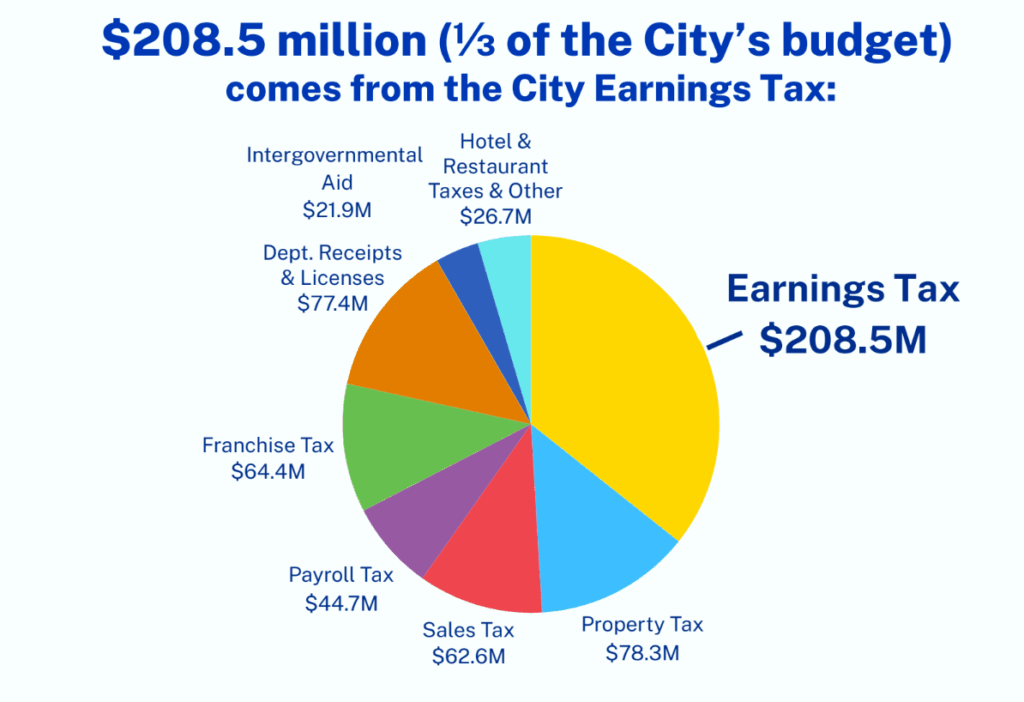
The city of St. Louis operates on an annual budget of approximately $607 million, with about $208.5 million—roughly 36% of general revenue—coming from the earnings tax. Other major revenue sources include:
- Property taxes ($78.3 million)
- Sales tax ($62.6 million)
- Payroll tax ($44.7 million)
- Franchise taxes ($64.4 million)
- Licenses and receipts ($77.4 million)
- Intergovernmental aid ($21.9 million)
- Hotel, restaurant, and other taxes ($26.7 million)
Much of that spending isn’t visible day to day. Large portions go toward administration, employee benefits, debt, and restricted funds such as grants or operations like the airport.
What residents do experience is a smaller, visible share of spending—basic services that shape how the city functions day to day. That includes:
- Police department ($178.5 million)
- Corrections and juvenile detention ($55.5 million)
- Street maintenance ($8.1 million)
- Lighting ($2.6 million)
- Park maintenance ($12 million)
- Forestry work ($11.4 million)
- Neighborhood stabilization ($3.2 million)
- Equipment and vehicle maintenance ($15.9 million)
Taken together, the numbers tell a simple story: much of the budget is already spoken for. What remains goes to the core services people see and rely on every day—services that depend heavily on the earnings tax to keep the city functioning.
Why the city relies on the earnings tax
St. Louis operates within long-standing structural constraints. Decades of population decline and job losses have eroded its tax base, while its boundaries remain fixed—bounded by St. Louis County on one side and the Mississippi and Missouri rivers on the others—leaving no room for annexation or outward growth.
Within that context, the earnings tax plays a critical role. Many who pay it commute into the city from the county or Illinois and rely on city services. Without the tax, the city would be responsible for covering the full cost of services used by both residents and commuters—something residents alone cannot sustain.
Critics argue the tax discourages relocation and business investment in the city. But that may overstate its impact. As Daly put it, “If someone doesn’t want to come to St. Louis, they’ll come up with a list of reasons.” The earnings tax may be part of that decision, but factors like perceptions of crime or older building stock often carry more weight. It’s also worth noting that higher housing costs and property taxes in the county can offset much of the difference for individuals.
Mayor Spencer acknowledged concerns over the tax, but emphasized the tradeoff: “That question isn’t going away…we cannot eliminate the earnings tax without replacing it and still expect to maintain anything close to our current level of city services.”
What would happen without the earnings tax?
“There would be massive cuts across every department. We wouldn’t be able to operate anywhere near the way we do now,” Spencer said.
If voters do not reauthorize the earnings tax, that’s the reality the city is preparing for. The loss of the tax would mean reduced services, increased pressure on other revenue sources, or both—reshaping how the city operates at a basic level.
Replacing that revenue would not be straightforward. State law limits reliance on property taxes, and shifting more of the burden there could discourage homeownership and investment. Other options—such as increasing taxes on tourism, entertainment, or major events—would come with trade-offs, potentially raising costs and weakening related industries.
Ninth Ward Alderman Michael Browning framed the issue in terms of current service levels, telling First Alert 4, “I would ask people to look at the level of city services they’re receiving now. If they want it to be better, in that case, we need this money.”
City leaders have made a similar argument more broadly. The mayor emphasized that the tradeoffs are immediate and tangible: “In the short term, losing the tax would be a far greater deterrent to people [moving here] than keeping it. The cuts to basic services would be significant, and that would outweigh any benefit of eliminating the 1%.”
Collector of Revenue Gregory F.X. Daly put it more bluntly: “Nobody likes paying taxes, but the reality is that the city depends on this revenue to function. If it goes away, the question becomes: where is that money going to come from?”
What’s at stake in the vote
Mayor Spencer acknowledged that the earnings tax can be a burden, but framed it as necessary to maintain basic city functions. “We’re all members of a city, and we need a city that is safe and functional,” she said. “I understand that even a 1% tax can be a hardship for some people. But the alternative—losing this revenue—would be catastrophic.”
The vote comes down to a simple question: what happens if more than a third of the city’s general revenue disappears?
As Daly put it, “You can’t just throw away $210 million because you don’t like how it’s being spent.”
Because the earnings tax is the only item on the ballot, turnout will matter—and it likely won’t take many votes to decide the outcome.
St. Louis City voters will make that decision on April 7 (or by absentee ballot now through April 6). Find your April 7 polling place or check your registration status on the city’s Board of Election Commissioners website.