 No more parking studies or sustainability plans. No more BRT Band-Aids or streetcar fantasies. No more consultants paid to tell the city and select business owners what they want to hear. We know what needs to be done downtown, all that remains is to convince ourselves that we can change. We can reset the table downtown for a more vibrant future in three simple, affordable steps:
1) return all downtown streets to two-way
2) place on-street parking on all blocks 24/7
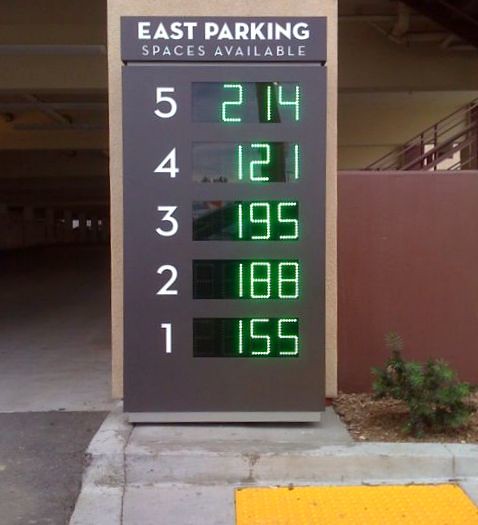
3) implement smart parking technology
Parking is a vexing problem for cities, right? St. Louisans love to drive, right? We simply won’t go somewhere if there isn’t easy parking, right? Maybe, maybe not. Many don’t want this to be true, including myself. As a couple hundred people heard this past week at the John Norquist presentation on the value of flexible street design, congestion isn’t just traffic, but also with money. Our most congested streets (not highways) are often our most prosperous (think Chicago’s Michigan Avenue, Delmar in The Loop, the CWE’s Euclid and Washington Avenue downtown).
To a large degree, the statements about parking above are true today, and more importantly, they are perceived to be true, by businesses, employers, developers and residents. We might as well accept them as fact, because they must be addressed. So parking can be difficult, confusing and unpredictable. It’s true for locals (I visit downtown frequently and will never remember which streets are one-way, and in which direction), but much more so for visitors.

{just a snapshot of one-way streets in STL’s CBD surrounding parking garages}

{the St. Louis CBD: two-way streets in green, one-way in red}
One way this challenge can be addressed it to build so many parking options that one is generally assured to stumble upon a place to park. This is what St. Louis has done and continues to do. Downtown is literally built to accomodate a 100-year parking event, such as when the Cardinals and Rams are both playing and one of the many downtown festivals is in full swing. In fact, even then parking garages fail to fill. And yet, even with the extordinary effort to overbuild parking, it’s estimated that 30% of traffic in central business districts is caused by vehicles searching for parking.

{the top of the Stadium West parking garage, adjacent to Busch Stadium, during game 2 of the 2011 World Series – photo by Steve Patterson}
The other way to address the challenge is to make existing parking more efficient. There’s no need for St. Louis to reinvent the wheel here. Cities such as San Francisco and Indianapolis are implementing smart parking technology. In each city, censors detect when an on-street parking space is available and monitor parking garages. Drivers can view available parking in real-time on their computer or dedicated phone app.

{a screenshot of real-time street parking availability in San Francisco}
New parking meters allow drivers to pay via credit card, or using their phone, but the best feature is dynamic pricing. One major goal of the San Francisco effort is to ensure that one parking space is generally available on each block, and that blocks rarely used attract more vehicles. To accomplish this, parking rates are automatically adjusted based on use. This is a boon to business owners, as it helps assure predictable parking access to customers and speeds parking turnover.
To make smart parking work, all downtown streets should be returned to two-way traffic flow. All of them. It doesn’t matter much if your phone tells you there’s an open parking spot two blocks to your left if one-way streets create a confusing maze between here and there. Street parking should be available on all downtown streets. The absence of such parking on the eastern blocks of Washington Avenue, for example, is bewildering and detrimental to the social and commercial life of the street.

{why are we still paying at meters like the one on the right?}
These are simple solutions, can be implemented quickly and are quite inexpensive in the context of the development of yet another parking garage. So why aren’t these ideas being implemented? Because ideas not first endorsed by downtown power interests rarely find support and no one speaks loudly for the larger interests of the city and its residents. Get these three points accomplished and then the city can plan from a position of stength. Then added investments can be built upon an effective planning basis.
Instead, the following scenario is playing out: the $500M+ Arch grounds renovation is handed over to an unaccountable non-profit. City streets are closed and re-routed. It’s decided to demolish one of the few profit centers for our Metro transit agency (the Arch garage). Other interests then insist that parking be replaced. At what cost? Perhaps $40K per space. We don’t even know how much parking exists downtown, or how efficiently it is utilized.

{in addition to real-time online access, local and highway signs can point to parking}
Who is served by this hapharzard approach to the enormously impactful issue of parking? In what way does this lead St. Louis to a more sustainable, more financial robust future? It doesn’t – not for the park, not for nearby businesses, visitors or residents. There should be no new parking facilities built, with very few exceptions, until the three actions above have been completed. A project cost of $20M would be very nearly equal to the estimated cost to demolish the Arch parking garage and construct a new 700-space facility one block away.

{this 540-space garage with 10K sq ft of retail was built by the City of St. Louis for $12.7M in 2009}

{garages are proposed for nearly all residential development – here, at the Park Pacific}
San Francisco spent just $5M on their SFpark project, receiving another $18M from the Department of Transportation. It’s a brilliant investment. In St. Louis, instead, we’re being told that spending $57M on a highway lid and additional ramps and infrastructure is the key to enticing millions of additional visitors to come downtown. Another $20M is needed to tear down a parking garage and building a new one. A couple hundred million dollars more is proprosed for other downtown highway projects. Why do we disconnect our traffic, streets, economic and parking policies?
How is it possible that given those options, the city wouldn’t take a wider view of the parking issue, addressing 10,000 spaces or more across the central business district? How is it possible that a new garage (or surface parking lot) could be endorsed and promoted?
So how does SFpark work?